75 biomarkers to guide your health journey.
What is a biomarker?
A biomarker is a measurable sign of a process in your body. In a blood test, it might be your vitamin D, glucose or cholesterol level.
These measurements help your specialist understand your nutritional status and guide recommendations based on your results.
Explore all biomarkers
Choose a category to jump to its markers, or search by name.
No biomarkers match your search.
Nutrients & micronutrients
See the vitamin, mineral and iron markers that help inform a discussion about your nutritional needs.
Vitamin DVitamin status
Vitamin D helps your body absorb calcium and supports normal bone and muscle function.
The blood test assesses your vitamin D status. Low levels can contribute to bone pain and muscle weakness.
Your GeneFuel specialist can use the result to guide appropriate nutritional changes or supplementation. Taking more is not always better.
Vitamin B12Vitamin status
Vitamin B12 helps maintain your nerves and make healthy red blood cells.
Your result checks the amount of B12 in your blood. Low levels can be relevant when investigating tiredness, tingling or changes in sensation.
Reviewing B12 alongside your diet, symptoms and blood count helps your specialist decide whether nutritional advice or further assessment is appropriate.
FolateVitamin status
Folate is a B vitamin your body needs to make DNA and new cells, including red blood cells.
The test checks folate in your blood. A low result can help explain some changes in your blood count.
Looking at folate alongside B12 helps your specialist review nutritional needs without assuming that every cause of tiredness is a vitamin deficiency.
MagnesiumMineral status
Magnesium supports nerve signals, muscle contraction and the processes that release energy from food.
The test checks magnesium in your blood. This does not capture all the magnesium stored in your tissues.
Your specialist can consider the result alongside your diet, medicines and kidney function before recommending changes to your intake.
ZincMineral status
Zinc helps your immune system function normally and supports wound healing, taste and smell.
The test measures zinc in your blood. Illness, sample timing and other factors can affect the result.
Your specialist can assess whether your intake needs attention. This also helps avoid unnecessary high-dose zinc, which can interfere with copper absorption.
CopperMineral status
Copper helps your body use iron and maintain healthy nerves and connective tissue.
The blood result gives one part of the picture of your copper status. Inflammation and hormonal factors can affect it.
Your specialist can review copper alongside zinc, your diet and any supplements before deciding whether a change is appropriate.
FerritinIron status
Ferritin is a protein that stores iron for your body to use.
The result helps assess your iron reserves. Ferritin can also rise with inflammation, so a higher result does not always mean excess iron.
Together with your blood count and other iron results, ferritin helps your specialist assess whether low iron stores may need attention.
Omega-3 indexFatty-acid status
The omega-3 index shows how much EPA and DHA is present in your red blood cells.
It reports these two omega-3 fats as a percentage of the cells’ fatty acids, reflecting intake over time.
Your specialist can use it to discuss oily fish or suitable supplementation and review how your levels change after adjustments to your routine.
IronIron status
Iron is needed to make the haemoglobin that carries oxygen around your body.
This result checks circulating iron. Levels vary, so it is interpreted with ferritin and iron-binding measures.
The combined results help your specialist review iron availability before recommending changes.
UIBCUnsaturated iron-binding capacity
Unsaturated iron-binding capacity describes the unused capacity of your blood to carry iron.
It estimates how much additional iron could bind to transferrin, the main iron-transport protein.
Read alongside iron and ferritin, it adds context to a review of possible iron shortage or excess.
TIBCTotal iron-binding capacity
Total iron-binding capacity describes your blood’s capacity to bind and transport iron.
The result reflects iron-binding capacity rather than the amount of stored iron.
Together with iron and transferrin saturation, it helps your specialist make sense of your iron results.
Transferrin saturationIron saturation
Transferrin saturation shows how much of your iron-carrying capacity is being used.
It compares circulating iron with total iron-binding capacity and reports a percentage.
It helps your specialist interpret iron availability alongside ferritin, rather than relying on one result.
CalciumMineral status
Calcium supports your bones, muscle contraction, nerve signals and blood clotting.
The blood test checks circulating calcium. It does not measure bone strength or directly show how much calcium you eat.
Your specialist can review calcium with albumin, vitamin D and kidney markers to decide whether the result needs further assessment.
Copper : Zinc ratioCalculated mineral ratio
This calculation compares your copper result with your zinc result.
It describes the relationship between the two measurements. It does not establish a deficiency or show that you need to change either supplement.
Your specialist can review the individual results and your current intake before discussing any nutritional changes.
Metabolic & blood sugar
Explore the glucose and insulin markers your specialist reviews when discussing your metabolic health.
Fasting glucoseBlood sugar
Glucose is a major source of fuel for your cells. Insulin helps regulate how much remains in your blood.
This test checks blood glucose after fasting, providing a snapshot of your blood sugar at that time.
Alongside HbA1c and your history, the result can guide a discussion about food, movement and whether further clinical assessment is needed.
HbA1cBlood sugar over time
HbA1c gives a longer view of your blood sugar than a single glucose reading.
It measures glucose attached to haemoglobin and reflects average blood sugar over roughly the past two to three months.
Tracking it helps your specialist review longer-term patterns. Some blood conditions affect its accuracy, so it is considered alongside your other results.
Fasting insulinInsulin marker
Insulin is the hormone that helps glucose move from your blood into your cells.
The test measures insulin after fasting. Interpreting it with glucose provides more context than either result alone.
Your specialist can use the pattern to inform a metabolic health review and discuss appropriate nutrition, activity or further assessment.
HOMA-IRCalculated insulin-resistance index
HOMA-IR estimates insulin resistance using your fasting glucose and insulin results.
It is a calculation, rather than a separate blood test, and provides an estimate of how your body responds to insulin.
Your specialist can consider it alongside HbA1c, medical history and other risk factors. It does not diagnose diabetes on its own.
Uric acidMetabolic marker
Uric acid forms when your body breaks down purines, substances found in your cells and some foods.
The test checks how much uric acid is in your blood. Higher levels can increase the likelihood of gout, although not everyone develops symptoms.
The result can support a review of diet, alcohol, medicines and kidney function, with medical follow-up where needed.
Hormonal & thyroid
Explore hormone and thyroid markers alongside your life stage, history and the changes you want to discuss.
TSHThyroid marker
TSH is the signal from your brain that tells your thyroid how much hormone to produce.
The result helps assess whether your thyroid may be underactive or overactive. It is interpreted with thyroid hormone levels.
This can add useful context when discussing symptoms such as tiredness, temperature sensitivity or changes in weight, and whether further assessment is needed.
Free T3Thyroid hormone
T3 is a thyroid hormone involved in how your body uses energy and regulates temperature.
Free T3 measures the portion circulating without being attached to proteins. Its meaning depends on TSH and other thyroid results.
Your specialist can review the pattern with your symptoms and medicines. The number alone does not explain your energy levels.
Free T4Thyroid hormone
T4 is the main hormone released by your thyroid. Your body converts some of it into T3.
Free T4 measures the portion not attached to proteins, providing information about the thyroid hormone available in your blood.
Looking at free T4 with TSH helps your specialist assess whether thyroid function may warrant further clinical review.
Anti-TPO antibodiesThyroid antibodies
These antibodies can show that your immune system is reacting to thyroid peroxidase, an enzyme involved in making thyroid hormones.
The test looks for antibodies associated with autoimmune thyroid conditions. A positive result does not, by itself, show how well your thyroid works.
Your specialist can review the result with TSH, thyroid hormones and your history to identify appropriate follow-up.
Thyroglobulin antibodiesThyroid antibodies
Thyroglobulin is a protein used by your thyroid to make hormones. This test checks for antibodies against it.
The result can add evidence of an immune response involving your thyroid. It is different from measuring thyroglobulin itself.
Reviewing it alongside other thyroid tests helps your specialist decide whether an underlying thyroid concern needs medical assessment.
OestradiolHormone marker
Oestradiol is a form of oestrogen involved in reproductive function and maintaining bone health.
The result shows the level at the time of testing. Menstrual cycle stage, menopause and hormone medicines can change its meaning.
Your specialist can relate the result to your life stage and symptoms, rather than treating a normal cycle-related change as a problem.
ProgesteroneHormone marker
Progesterone helps prepare the lining of the womb after ovulation and supports early pregnancy.
Levels change substantially through the menstrual cycle. Sample timing is essential when using the result to assess whether ovulation has occurred.
Your specialist can review the result against cycle dates and hormone medicines to decide whether further assessment would be useful.
TestosteroneHormone marker
Testosterone contributes to sexual function, muscle and bone health in both women and men.
This result measures total testosterone, including hormone attached to proteins. Levels vary with age, sample timing and other factors.
Reviewing it with SHBG, symptoms and relevant history helps your specialist assess whether a hormone concern needs further investigation.
SHBGHormone-binding protein
SHBG is a protein that binds hormones, including testosterone, as they travel through your blood.
The test measures this binding protein. Changes in SHBG can alter how much testosterone is available to your tissues.
It helps your specialist interpret total testosterone more accurately, particularly when the number does not seem to fit your symptoms.
Free androgen index (FAI)Calculated hormone index
The free androgen index compares total testosterone with SHBG.
This calculated index helps assess androgen availability in appropriate clinical settings. It is not a direct measurement of free testosterone.
Your specialist can consider it when reviewing symptoms of androgen excess, alongside other hormone results and your medical history.
FSHHormone marker
Follicle-stimulating hormone helps regulate egg development in the ovaries and sperm production in the testes.
The blood result reflects one part of the communication between your brain and reproductive organs. Age and menstrual cycle timing affect interpretation.
Your specialist can review FSH with LH and other hormones when discussing reproductive health or changes around menopause.
LHHormone marker
Luteinising hormone helps trigger ovulation and signals the testes to produce testosterone.
The test measures LH at the time of sampling. Its level can rise sharply around ovulation.
Reading LH with FSH, other hormones and cycle timing helps your specialist understand the pattern and decide whether further review is appropriate.
ProlactinHormone marker
Prolactin is best known for its role in milk production, but it also affects reproductive hormone signalling.
The test checks prolactin in your blood. Pregnancy, medicines and stress around sampling can influence the result.
Your specialist can consider it when reviewing changes in periods, sexual function or unexpected breast milk production, with medical follow-up when needed.
DHEA-SHormone marker
DHEA-S is made mainly by your adrenal glands and helps your body produce other sex hormones.
The test measures DHEA-S in your blood. Levels naturally change with age and need to be interpreted in that context.
It can add information to a review of androgen-related symptoms. A low result is not, by itself, a reason to take DHEA supplements.
Free testosteroneHormone marker
Free testosterone is the small portion of testosterone that is not attached to proteins in your blood.
The result adds context to total testosterone, particularly when SHBG levels affect how much hormone is available.
Your specialist can compare the results with your symptoms and sample timing before deciding whether a further hormone assessment is appropriate.
CortisolHormone marker
Cortisol helps regulate blood sugar, blood pressure and your response to stress.
The test checks cortisol at a particular time. Levels follow a daily rhythm and are affected by illness, medicines and sampling conditions.
Your specialist can assess whether the result needs follow-up. A single blood reading cannot measure your overall stress burden or diagnose burnout.
Cardiovascular
Get to know the cholesterol and related markers you can discuss with your specialist.
Total cholesterolLipid marker
Cholesterol is needed to build cells and make hormones, but excess cholesterol in some particles can contribute to artery disease.
Total cholesterol gives an overall measurement. It does not show how cholesterol is distributed between different particles.
Your specialist reviews it with LDL, HDL and other risk factors to identify which parts of your cardiovascular health need attention.
HDL cholesterolLipid marker
HDL particles help carry cholesterol away from tissues towards the liver.
This test measures the cholesterol carried in HDL. A higher number is not an unlimited guarantee of protection.
Your specialist considers HDL with the rest of your lipid results, rather than treating it as a target to raise in isolation.
LDL cholesterolLipid marker
LDL particles carry cholesterol through your blood. Excess LDL contributes to cholesterol building up in artery walls.
The result measures the cholesterol carried in LDL particles.
It helps your specialist discuss cardiovascular risk and whether dietary changes or further clinical advice are appropriate for you.
Non-HDL cholesterolCalculated lipid marker
Non-HDL cholesterol includes cholesterol carried by the main particles linked with artery plaque.
It is calculated by subtracting HDL from total cholesterol, giving a broader view than LDL alone.
Your specialist can use it alongside other risk factors to review cardiovascular health and changes over time.
TriglyceridesLipid marker
Triglycerides are fats your body uses to store energy.
The result measures triglycerides in your blood. Recent food, alcohol and metabolic health can influence the level.
Reviewing the result with glucose and cholesterol can help your specialist discuss eating patterns, alcohol intake and activity, or recommend further medical assessment.
Apo AApolipoprotein
Apo A refers here to the protein associated with HDL particles, which help transport cholesterol.
The result adds information about these particles alongside the amount of cholesterol carried in HDL.
Your specialist can consider it with Apo B and your lipid profile when reviewing cardiovascular risk.
Apo BApolipoprotein
Apo B is a protein carried by particles that can contribute to plaque in your arteries.
The result helps assess the number of these particles, adding information beyond the amount of cholesterol they carry.
Your specialist can use it when reviewing cardiovascular risk, particularly when LDL cholesterol and other lipid results give different signals.
Lipoprotein(a)Lipoprotein marker
Lipoprotein(a), or Lp(a), is a cholesterol-carrying particle whose level is largely inherited.
A raised result can add to cardiovascular risk even when routine cholesterol results look reassuring.
Knowing your level can inform a broader prevention discussion. Diet and exercise usually have little effect on Lp(a) itself, so other risk factors remain important.
HomocysteineCardiovascular marker
Homocysteine is produced as your body processes an amino acid called methionine. B vitamins help process it further.
The result can rise when folate or B12 is low, but kidney function and other factors also matter.
It can help focus a nutritional review. Lowering the number with supplements does not automatically mean a lower risk of heart disease.
Cholesterol : HDL ratioCalculated lipid ratio
This ratio compares your total cholesterol with your HDL cholesterol.
It summarises the relationship between two lipid results. Different cholesterol levels can produce the same ratio.
Your specialist can use it as part of a wider cardiovascular review while still checking the individual cholesterol measurements.
Apo B : A ratioCalculated apolipoprotein ratio
This ratio compares Apo B with Apo A, bringing two different types of cholesterol-transport protein together.
The calculation adds context to the individual apolipoprotein results.
Your specialist can consider the pattern with your cholesterol levels and medical history. The ratio does not replace a full assessment of cardiovascular risk.
Trig : HDL ratioCalculated lipid ratio
This ratio compares your triglycerides with your HDL cholesterol.
It summarises the relationship between two blood-fat measurements. The units used affect the number.
Your specialist can review it with the individual lipid results and glucose markers. It does not diagnose insulin resistance or heart disease on its own.
Inflammation & immune balance
See which inflammation and blood-cell markers are included in your wider results review.
hs-CRPInflammation marker
C-reactive protein rises in response to inflammation. The high-sensitivity test detects smaller amounts of it.
The result can add information to a cardiovascular risk review, but recent illness or injury can also raise it.
Your specialist can consider whether the result reflects a temporary change and whether a repeat measurement or medical follow-up is appropriate.
HaemoglobinRed blood-cell marker
Haemoglobin is the protein in red blood cells that carries oxygen to your tissues.
The test measures haemoglobin concentration. A low result can indicate anaemia, which may contribute to fatigue or breathlessness.
Your specialist can review it with iron, B12, folate and the rest of your blood count to identify what needs further investigation.
PlateletsBlood-cell marker
Platelets help your blood form clots to stop bleeding.
The test counts platelets in your blood. It does not directly measure how well they work.
Your specialist can review an unusual count alongside your history and other blood results, and advise on medical follow-up rather than assuming it reflects a nutritional problem.
White cell countWhite blood-cell count
White blood cells are part of your body’s defence against infection.
This measures their total number. Infection, inflammation, medicines and other factors can affect the count.
Your specialist can review the different white cell types and any recent illness to decide whether a change needs further assessment.
HCTHaematocrit
Haematocrit describes how much of your blood is made up of red blood cells.
The result adds context to haemoglobin and red cell count. Hydration can affect it.
Your specialist can use the combined pattern when reviewing possible anaemia or other blood changes, rather than interpreting the percentage alone.
MCVMean corpuscular volume
MCV describes the average size of your red blood cells.
Smaller or larger cells can point towards different causes of anaemia, but the result is not diagnostic on its own.
Your specialist can compare it with iron, B12 and folate results to guide further review.
MCHMean corpuscular haemoglobin
MCH describes the average amount of haemoglobin in each red blood cell.
It adds detail to your blood count and often changes alongside red cell size.
Your specialist can use the pattern with other blood results to assess whether further investigation of anaemia is appropriate.
RDWRed cell distribution width
RDW shows how much your red blood cells vary in size.
Greater variation can occur with several blood or nutritional changes. A raised result does not identify the cause.
Reviewing RDW with MCV, haemoglobin and nutrient results helps your specialist decide which changes need closer attention.
MCHCMean corpuscular haemoglobin concentration
MCHC describes how concentrated the haemoglobin is inside your red blood cells.
It complements MCH, which measures the amount per cell, and MCV, which describes cell size.
Your specialist can use these results together when reviewing a blood count that may need further assessment.
Red cell countRed blood-cell count
Red blood cells transport oxygen from your lungs to the rest of your body.
This test counts the cells in a given volume of blood. Cell number alone does not show their size or haemoglobin content.
Your specialist can review the count with haemoglobin and other blood measurements when discussing fatigue, breathlessness or an unexpected result.
NeutrophilsWhite blood-cell differential
Neutrophils are white blood cells that help fight infection.
The result counts this cell type as part of your blood differential.
It helps your specialist review changes in your overall white cell count and decide whether follow-up is needed.
MonocytesWhite blood-cell differential
Monocytes help remove germs and clear away dead cells.
The result counts monocytes within your white blood cell profile.
Your specialist can review this alongside the other cell types, keeping your symptoms and recent health in context.
EosinophilsWhite blood-cell differential
Eosinophils are involved in allergic responses and defence against parasites.
The result counts this particular type of white blood cell.
It adds context to your blood count. Your specialist can discuss whether an unexpected result needs further assessment.
BasophilsWhite blood-cell differential
Basophils are a small group of white blood cells involved in allergic reactions.
The result measures their number within your blood differential.
Your specialist can interpret the count alongside the other white cells and your history, rather than treating it as a standalone allergy test.
LymphocytesWhite blood-cell differential
Lymphocytes include cells that recognise infections and coordinate immune responses.
The test counts lymphocytes in your blood.
Your specialist can review the number with the rest of your blood differential when deciding whether an unusual pattern needs medical follow-up.
Liver & kidney
Explore the liver and kidney markers your specialist reviews alongside the rest of your results.
ALTLiver enzyme
ALT is an enzyme found mainly in liver cells.
The test checks ALT in your blood. Levels can rise when liver cells are injured, although the result does not identify the cause.
Your specialist can review ALT with other liver markers, medicines, supplements and your history to decide whether further clinical assessment is needed.
ASTLiver enzyme
AST is an enzyme found in the liver, muscles and other tissues.
An increased blood level can reflect changes in more than one part of the body, so it is not specific to the liver.
Your specialist can interpret AST with ALT and other results, taking recent exercise and your health history into account.
ALPEnzyme marker
Alkaline phosphatase is an enzyme found especially in the liver, bile ducts and bones.
The result checks ALP in your blood. A raised level does not reveal which tissue it came from.
Reviewing ALP with GGT and other markers helps your specialist decide whether the pattern needs further liver or bone-related assessment.
GGTLiver enzyme
GGT is an enzyme used to help assess changes involving the liver and bile ducts.
A higher result can occur for several reasons, including alcohol use and some medicines.
Your specialist can review GGT with ALP and other liver results to decide what needs attention. The number is not a direct measure of how much alcohol you drink.
BilirubinLiver marker
Bilirubin is produced when your body breaks down old red blood cells. Your liver helps process and remove it.
The test measures bilirubin in your blood. Raised levels can have several causes, including changes in red cell breakdown or liver processing.
Your specialist can review it with your blood count and liver markers to advise on appropriate follow-up.
AlbuminBlood protein
Albumin is a protein made by your liver. It helps keep fluid in your blood vessels and carries substances around your body.
The result can be influenced by hydration, inflammation and liver or kidney conditions.
Your specialist can use it alongside other markers to assess the wider pattern. It is not a direct measure of how much protein you eat.
Total proteinBlood proteins
Total protein measures the combined amount of albumin and globulins in your blood.
These proteins help transport substances, maintain fluid balance and support immune functions. Different changes can produce the same total result.
Your specialist can compare total protein with albumin, globulin and other results to decide whether further assessment is needed.
CreatinineKidney marker
Creatinine is a waste product from normal muscle activity that your kidneys remove from the blood.
The test measures blood creatinine. Muscle mass, diet and other factors can affect it, as well as kidney function.
Your specialist can review it with eGFR and your history to assess whether a change needs follow-up.
eGFRKidney function estimate
eGFR estimates how effectively your kidneys filter your blood.
It is calculated using a kidney marker such as creatinine and other information. It is an estimate, and some body types or circumstances affect its accuracy.
Looking at the trend alongside other results helps your specialist decide whether your kidney health needs further assessment.
SodiumElectrolyte
Sodium helps regulate fluid balance and supports normal nerve and muscle function.
The blood test checks its concentration. The result reflects the balance between water and sodium, rather than simply how much salt you eat.
Your specialist can consider hydration, medicines and other results to decide whether an unusual level needs medical review.
GlobulinBlood protein
Globulins are a group of blood proteins involved in transport and immune defence.
This result gives an overall globulin level. It does not distinguish between every individual protein in the group.
Your specialist can compare it with albumin, total protein and your wider results to decide whether further testing would be useful.
ALT : AST ratioCalculated liver-enzyme ratio
This calculation compares the two liver-related enzyme results, ALT and AST.
It describes their relationship but does not show the cause of an abnormal result. AST can also come from muscles and other tissues.
Your specialist can consider the ratio with the individual enzyme levels and your history. It does not provide a standalone diagnosis.
From blood results to your morning and evening scoops.
Your specialist helps you understand the findings, guides your personalised formulations and reviews your progress with you.

Talk through what your results mean
Bring your questions and goals to a review with a GeneFuel specialist.

Make it part of your morning and evening
One scoop in the morning and one in the evening, with formulations informed by your results.
See what changes over time
Follow your results in your dashboard and revisit your routine with your specialist.
Know what to expect from your results.
What is a biomarker?
A biomarker is something measurable in your blood, such as a nutrient level. GeneFuel reviews these results alongside your history and goals to inform nutritional recommendations.
Will I have to interpret the results myself?
No. Your results arrive in your dashboard, and a trained GeneFuel specialist reads them in full before you meet. On your video consultation, they take you through what your biology is showing and what it means for you.
How do my results shape my supplements?
Your specialist evaluates your results alongside your goals, then designs your protocol and signs it off before anything is formulated. It arrives as bespoke AM and PM formulations, made for you alone. We do not publish doses or combinations, because those are designed for you, not for a website.
Can I follow my results over time?
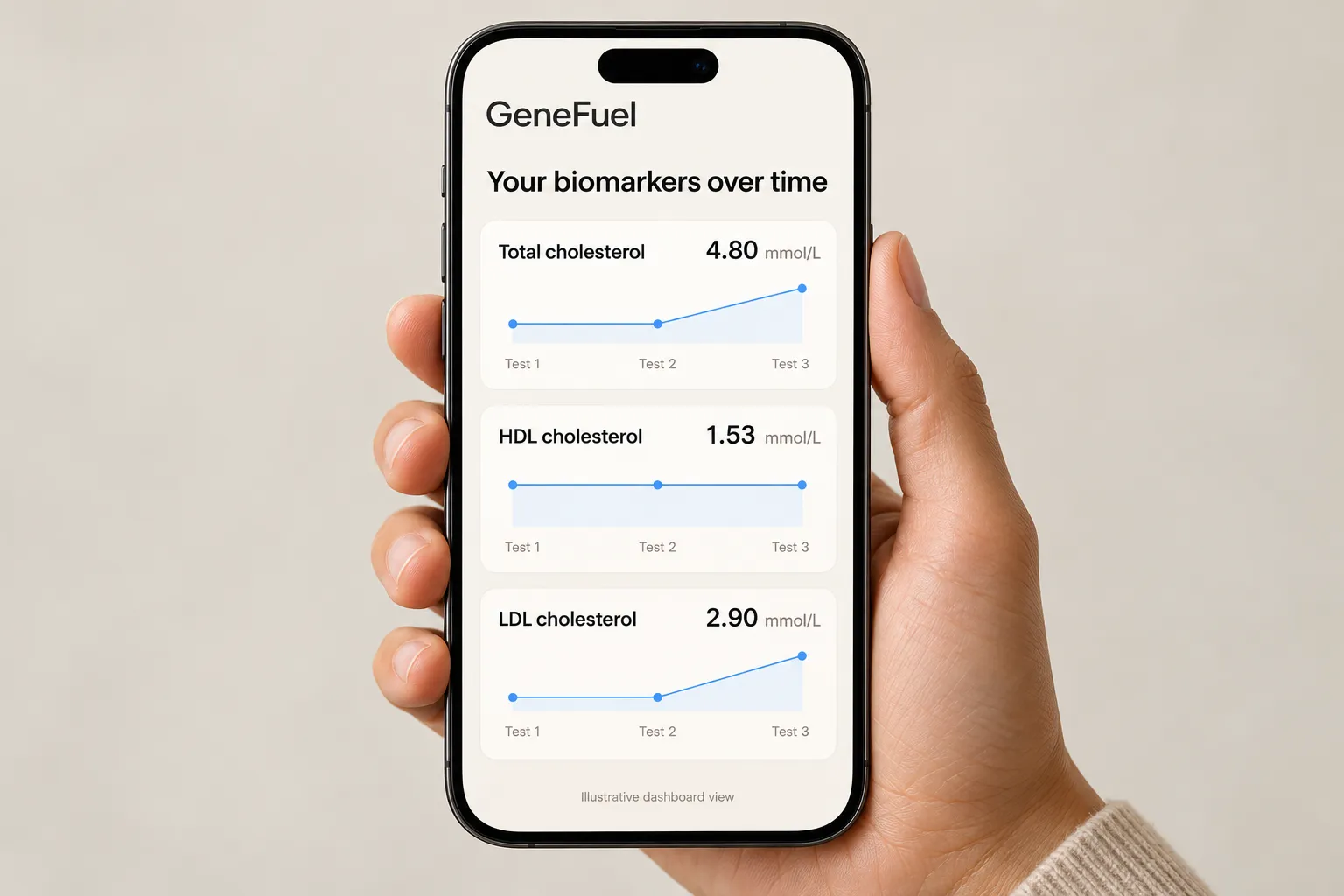
Yes. Your dashboard holds every result, with your biomarkers and biological age read against your own baseline. Each retest adds to the picture, and your protocol is revised where the data supports it, with the reasons explained. If you connect a Whoop or an Oura, that data sits alongside it.
Does GeneFuel diagnose or treat conditions?
No. GeneFuel is a data-led supplementation system. We do not diagnose, treat or cure anything, and we are not a substitute for your GP or any medical care you are receiving. If something in your results warrants medical attention, your specialist will tell you to see a doctor.
Build your supplement routine around your blood results.
Bring blood testing, specialist guidance and personalised morning and evening formulations together in one membership.